


Heel-to-Toe Walking Test: What It Reveals About Balance and Gait
Walking in a straight line may seem simple, but placing one foot directly in front of the other, with the heel touching the opposite toes, can be surprisingly challenging. This movement, known as heel-to-toe walking or tandem walking, requires balance, coordination, and precise control of body position.
Healthcare professionals use the heel-to-toe walking test to assess aspects of neurological function and walking stability. The same movement can also be practiced as a balance exercise. But what does it mean if you struggle to walk heel to toe? Could it indicate an underlying condition, and can rehabilitation help?
Understanding the purpose of tandem gait testing, the possible causes of difficulty, and the available rehabilitation approaches can help you take the next appropriate step.
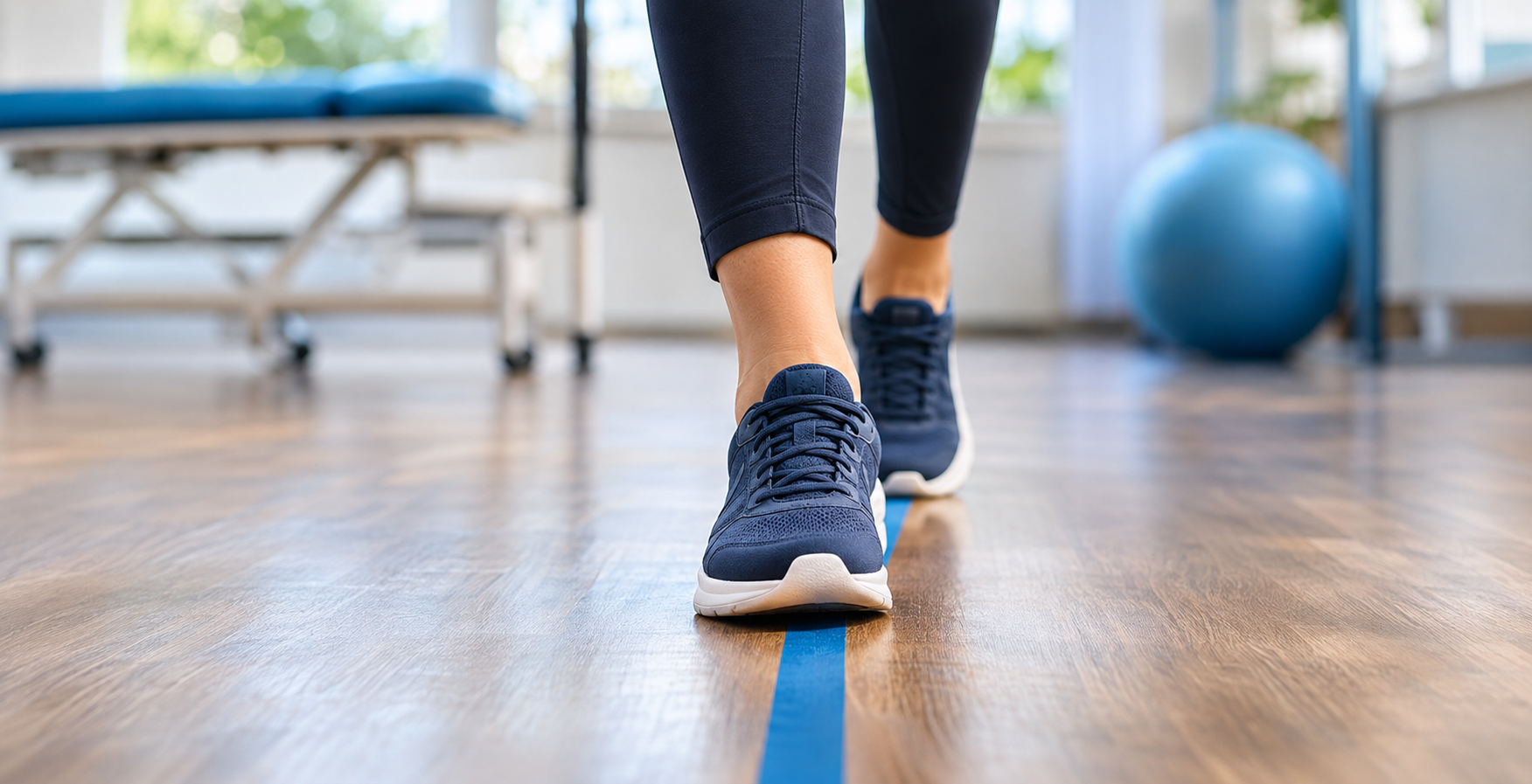
What Is Heel-to-Toe Walking (Tandem Gait)?
Heel-to-toe walking, also called tandem walking or tandem gait, is a movement in which each foot is placed directly in front of the other, with the heel of the leading foot touching or nearly touching the toes of the foot behind it.
Unlike ordinary walking, where the feet are usually positioned slightly apart, tandem walking creates a narrow base of support. This makes maintaining balance more challenging and requires coordination between the nervous system, muscles, and sensory systems.
Tandem walking is commonly used in neurological examinations and balance assessments. It is also included in exercise programs designed to practice balance and coordination.
How Is the Heel-to-Toe Walking Test Performed?
The heel-to-toe walk test, or tandem gait test, is a clinical assessment in which a person walks along a straight line while placing one foot immediately in front of the other.
During a typical assessment, the healthcare professional asks the patient to:
- Stand upright on a level surface.
- Look straight ahead.
- Place one foot directly in front of the other, touching heel to toe.
- Continue walking along a straight line for the requested number of steps.
- Maintain balance while the examiner observes their movement.
The examiner may observe whether the patient can maintain a straight path, how accurately the feet are positioned, whether the body sways, and whether additional support is needed.
Some standardized protocols use ten consecutive steps, while other clinical assessments may use different distances, conditions, or scoring methods.
Important: The tandem gait test should be performed under appropriate supervision when balance difficulties or fall risks are present. A self-administered test cannot establish a neurological diagnosis.
What Does the Tandem Gait Test Assess?
The tandem gait test helps healthcare professionals evaluate several functions involved in maintaining balance during movement.
- Dynamic balance: The ability to remain stable while walking.
- Motor coordination: The ability to organize and control movements smoothly.
- Proprioception: The body's awareness of the position and movement of its limbs.
- Neurological function: The contribution of nervous system pathways involved in balance and coordinated movement.
Tandem gait assessment can form part of a broader neurological examination, particularly when clinicians suspect problems affecting coordination or balance.
However, the test does not identify a specific disease on its own. Results must be interpreted alongside medical history, symptoms, physical examination findings, and other assessments when necessary.
Why Is Heel-to-Toe Walking Difficult for Some People?
Difficulty with tandem walking can occur for several reasons. Because the movement requires a narrow base of support, it can reveal balance and coordination problems that are less noticeable during ordinary walking.
Possible contributing factors include:
1. Vestibular disorders
The vestibular system, located in the inner ear, helps the body maintain balance and spatial orientation. Vestibular dysfunction may contribute to unsteadiness during walking, particularly under challenging balance conditions.
2. Cerebellar dysfunction
The cerebellum plays an important role in coordinating movement and maintaining balance. Conditions affecting cerebellar function may cause an unsteady or poorly coordinated walking pattern, sometimes described as ataxic gait.
3. Impaired proprioception
Proprioception allows the nervous system to detect the position and movement of the limbs. When this sensory information is impaired, accurate foot placement and balance may become more difficult.
4. Neurological conditions
Conditions such as stroke, multiple sclerosis, and other neurological disorders can affect walking through changes in coordination, muscle control, sensation, or balance. The specific walking difficulties depend on the structures and functions involved.
5. Musculoskeletal limitations
Muscle weakness, joint pain, restricted movement, and other musculoskeletal problems may also affect walking stability and the ability to perform challenging balance tasks.
Does Difficulty Walking Heel to Toe Mean You Have a Neurological Disorder?
No. Difficulty with heel-to-toe walking does not automatically indicate a neurological disorder.
Performance may be influenced by multiple factors, including age, physical limitations, sensory function, and the conditions under which the test is performed.
A healthcare professional can determine whether further evaluation is necessary.
New or worsening balance problems should not be ignored. Sudden difficulty walking, particularly when accompanied by weakness, facial drooping, speech difficulties, or other acute neurological symptoms, requires emergency medical evaluation.
Can Heel-to-Toe Walking Exercises Improve Balance?
Heel-to-toe walking is also used as a balance exercise. The movement challenges stability during walking and provides an opportunity to practice controlled foot placement and coordination. The NHS and other public health organizations include heel-to-toe walking in balance exercise recommendations.
How to Practice the Heel-to-Toe Walking Exercise
For individuals who can safely perform the exercise, the basic movement involves:
- Standing upright beside a stable support, such as a wall or countertop.
- Looking forward rather than down at the feet.
- Placing one heel directly in front of the opposite toes.
- Slowly transferring weight before taking the next step.
- Continuing for approximately five steps initially, progressing gradually as balance improves.
Support should remain available throughout the exercise. People with significant balance difficulties, recent falls, or neurological conditions should seek guidance from a qualified healthcare professional before attempting it. The exercise may be incorporated into a broader balance training program, but it is not appropriate for every patient.
What Is the Difference Between Tandem Walking and Gait Rehabilitation?
Although tandem walking and gait rehabilitation both involve walking-related skills, they serve different purposes.
| Tandem walking | Gait rehabilitation | |
|---|---|---|
| Primary purpose | Assess or practice balance and coordination | Address identified walking limitations |
| Main focus | Maintaining stability during heel-to-toe steps | Functional walking ability |
| Application | Clinical testing or balance exercise | Individualized rehabilitation program |
| Professional involvement | Required for clinical assessment and when safety is a concern | Guided by rehabilitation professionals |
| Scope | One specific walking task | May include strength, balance, coordination, sensory function, and walking mechanics |
Tandem walking focuses on a particular movement pattern. Gait rehabilitation takes a broader approach, addressing the factors that affect a person's ability to walk safely and effectively in everyday situations.
What If Walking Difficulties Go Beyond Balance?
When walking difficulties affect daily activities, repeating a single balance exercise may not address the underlying problem.
A comprehensive gait assessment can help identify whether the main limitations involve muscle weakness, impaired coordination, reduced sensation, joint restrictions, or other factors.
Depending on the patient's condition, a rehabilitation program may include:
- Strengthening exercises for muscles involved in walking.
- Balance and postural control training.
- Repeated practice of functional walking movements.
- Exercises addressing coordination and motor control.
- Task-specific training, including turning, stepping, and negotiating obstacles.
The rehabilitation goals are determined by a qualified healthcare professional based on the patient's medical condition, functional abilities, and individual needs.
For some patients, the goal may be to regain walking abilities following an injury. For others, it may involve maintaining mobility, improving walking efficiency, or increasing safety during daily activities.
How Can Just Walk Support Gait Rehabilitation?
When walking difficulties require more than isolated balance exercises, rehabilitation technologies may provide additional ways to incorporate functional movement practice into a treatment program.
Just Walk™, offered by Chaban Medical, is a wearable neuromotor rehabilitation system designed for individuals with neurological or orthopedic conditions affecting movement and walking.
Unlike conventional walking aids that primarily provide external support, Just Walk is designed to apply mechanical resistance during active movement.
The system incorporates several features relevant to gait rehabilitation:
- Adjustable resistance: Four resistance levels allow the mechanical resistance to be adapted to the rehabilitation activity.
- Foot-lift assistance: The device is designed to assist foot lift during step initiation.
- Proprioceptive stimulation: Resistance during movement provides sensory input associated with limb position and motion.
- Functional movement practice: The wearable design allows resistance to be incorporated into walking and other appropriate rehabilitation exercises.
- Portable design: The system can be incorporated into suitable clinical or home-based rehabilitation programs.
Just Walk is designed for use in rehabilitation involving conditions such as stroke, Parkinson's disease, multiple sclerosis, traumatic brain injury, and certain orthopedic impairments.
Its suitability depends on the patient's condition and the rehabilitation goals established by a qualified healthcare professional.
It is important to distinguish the device's intended functions from demonstrated clinical outcomes. Just Walk is not a diagnostic tool, and its use should not be interpreted as a proven treatment for an abnormal tandem gait test.
Interested in learning more about functional gait rehabilitation?
FAQ
?What is the difference between tandem gait and normal walking
During normal walking, the feet are generally positioned apart to provide a comfortable base of support. Tandem gait requires placing one foot directly in front of the other, creating a narrower base of support and making balance more challenging.
?What does an abnormal tandem gait test indicate
Difficulty performing the tandem gait test may indicate impaired balance or coordination. Possible contributing factors include vestibular dysfunction, sensory impairment, cerebellar disorders, and musculoskeletal limitations. The result alone cannot establish a diagnosis.
?Why can't I walk heel to toe without losing my balance
Heel-to-toe walking requires precise control of body position and foot placement. Difficulties may result from problems affecting balance, coordination, proprioception, strength, or other aspects of movement. Persistent or unexplained difficulties should be evaluated by a healthcare professional.
?Is heel-to-toe walking a good balance exercise
Yes. Heel-to-toe walking is included in balance exercise recommendations from organizations such as the NHS. However, it should be performed with appropriate support and adapted to individual abilities and safety needs.
How many steps are required for a tandem gait test?
The number of steps depends on the clinical protocol. Some standardized assessments use ten consecutive steps, while other examinations use different procedures. There is no single step count that establishes a diagnosis across all clinical settings.
?Can gait rehabilitation help people who have difficulty walking
Gait rehabilitation can address specific limitations affecting walking, including problems with strength, coordination, balance, and movement control. The appropriate exercises, technologies, and expected outcomes depend on the underlying condition and the individual's rehabilitation goals.
Important
This article is for informational purposes only and is not a substitute for professional medical advice; always consult your doctor or physical therapist before starting any exercise or using any device
Sources & References
Clinical assessment and tandem gait
- National Library of Medicine, StatPearls. Neurologic Exam. Discussion of gait assessment, tandem walking, cerebellar function, and neurological findings.
https://www.ncbi.nlm.nih.gov/books/NBK557589/ - National Library of Medicine, StatPearls. Gait Disturbances. Clinical evaluation and possible causes of abnormal gait.
https://www.ncbi.nlm.nih.gov/books/NBK560610/ - Procedure for Screening People on Standing Balance with Romberg Testing and Walking Balance with Tandem Walking. Journal of Visualized Experiments, 2023.
https://pmc.ncbi.nlm.nih.gov/articles/PMC10880181/ - Diagnostic Usefulness of 10-Step Tandem Gait Test for the Patient With Degenerative Cervical Myelopathy. Published clinical research, 2021.
https://pmc.ncbi.nlm.nih.gov/articles/PMC8390502/
Balance exercises and safety
- National Health Service (NHS). Balance Exercises. Instructions for heel-to-toe walking and other balance exercises.
https://www.nhs.uk/live-well/exercise/balance-exercises/ - NHS Inform. Strength and Balance Exercises. Heel-to-toe standing and walking exercises, progression, and safety guidance.
https://www.nhsinform.scot/healthy-living/preventing-falls/keeping-well/strength-and-balance-exercises - National Institute on Aging. Four Types of Exercise Can Improve Your Health and Physical Ability. Balance training and exercise safety.
https://www.nia.nih.gov/health/four-types-exercise-can-improve-your-health-and-physical-ability
Just Walk Official Distributor: +1-914-345-9300 Or +1-800-431-2830 👉 Become a Just Walk Distributor