


The TUG Test Explained: What It Measures and How to Improve Your Score
The Timed Up and Go (TUG) Test is one of the most widely used clinical tools for evaluating mobility, balance, and fall risk. Although it takes less than a minute to perform, the test provides valuable insights into how safely and efficiently a person moves during everyday activities.
Healthcare professionals use the TUG Test to assess individuals recovering from stroke, Parkinson's disease, multiple sclerosis, orthopedic surgery, and other conditions that affect walking and balance. The test also serves as an important benchmark throughout rehabilitation, helping therapists monitor progress and tailor treatment plans.
Understanding what the TUG Test measures and how its results can improve over time allows patients and caregivers to become more active participants in the rehabilitation process.
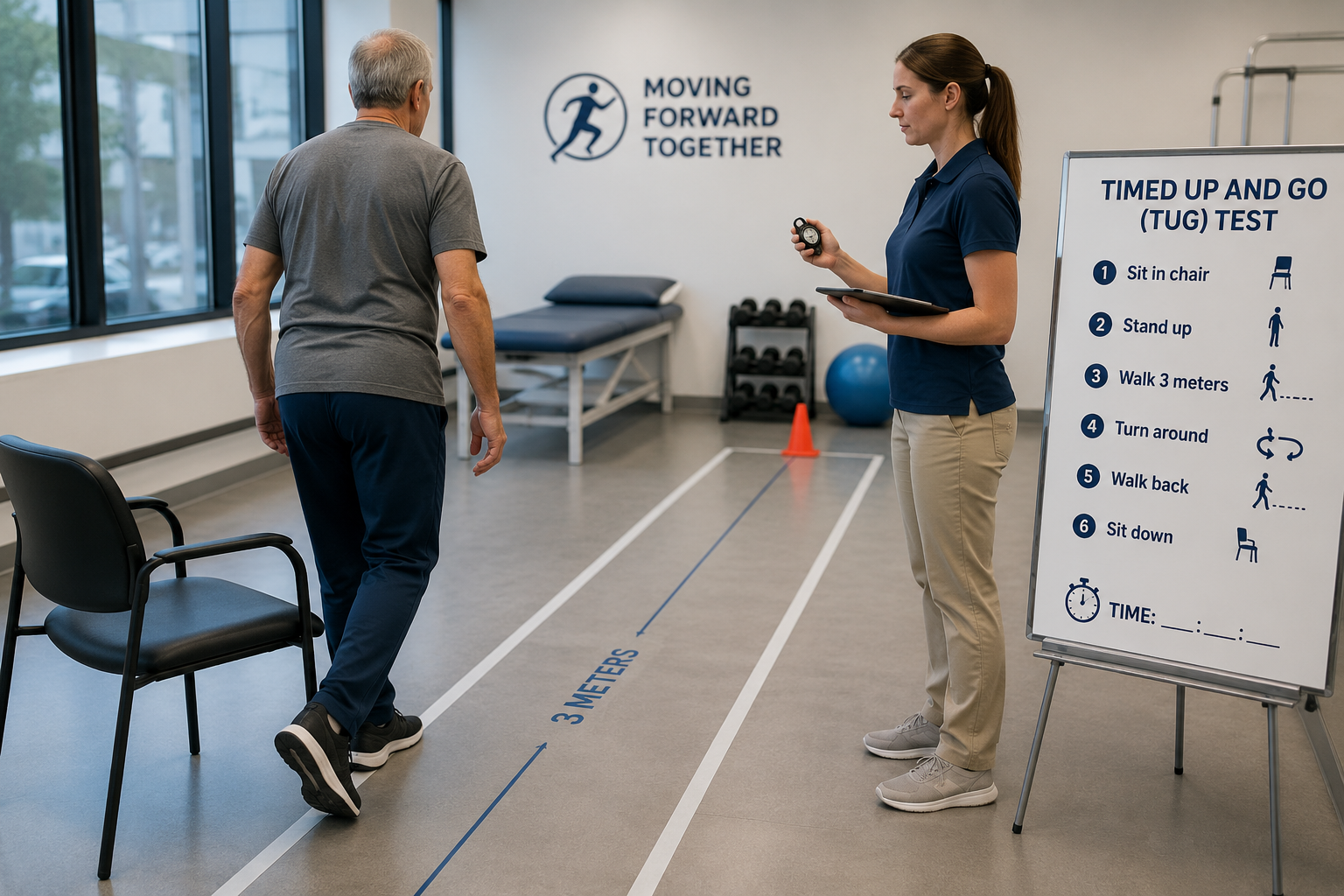
What Is the TUG Test?
The Timed Up and Go Test, commonly called the TUG Test, is a standardized functional mobility assessment designed to evaluate a person's ability to safely perform a sequence of everyday movements.
During the test, the patient:
- Sits in a standard chair.
- Stands up without assistance, if possible.
- Walks 3 meters (10 feet).
- Turns around.
- Walks back to the chair.
- Sits down again.
The therapist records the total time required to complete the task while also observing movement quality, balance, posture, walking pattern, and turning ability. Because the test combines several functional activities into one assessment, it offers a realistic picture of mobility in daily life.
What Does the TUG Test Measure?
Many people assume the TUG Test measures walking speed alone. In reality, it evaluates several important components of functional mobility.
These include:
- Standing balance
- Dynamic balance during walking
- Sit-to-stand ability
- Gait quality
- Turning control
- Coordination
- Functional independence
- Fall risk
For therapists, the TUG Test provides much more than a number. It helps identify which aspects of movement require additional rehabilitation. For example, one patient may complete the test slowly because of reduced leg strength, while another may struggle primarily with turning or maintaining balance. Understanding these differences helps clinicians develop personalized treatment plans.
Who Can Benefit from the TUG Test?
The TUG Test is commonly performed for people experiencing conditions that affect walking, balance, or mobility.
It is frequently used during:
- Stroke rehabilitation
- Parkinson's disease rehabilitation
- Multiple sclerosis rehabilitation
- Recovery after hip or knee replacement
- Traumatic brain injury rehabilitation
- Fall risk assessment in older adults
Because the assessment is quick, reliable, and easy to repeat, therapists often perform it multiple times throughout rehabilitation to objectively measure progress.
Rather than relying on subjective impressions, clinicians can compare results over weeks or months to determine whether mobility is improving.
Can You Improve Your TUG Test Score?
In many cases, yes.
Improving a TUG Test score is not about practicing the test itself. It is about improving the movement skills that the test evaluates.
A comprehensive rehabilitation program may focus on:
- Balance training
- Gait rehabilitation
- Strengthening the lower extremities
- Sit-to-stand practice
- Turning mechanics
- Weight shifting
- Functional mobility exercises
- Task-specific walking practice
One of the most important principles of neurological rehabilitation is repetition. Performing meaningful walking movements repeatedly helps reinforce more efficient motor patterns and supports neuroplasticity, the brain's ability to reorganize and adapt after injury.
As balance, coordination, and walking quality improve, many patients demonstrate better functional mobility, which may be reflected in improved TUG Test performance over time.
How Just Walk Supports Functional Mobility Training
The TUG Test measures real-world mobility, not simply how fast someone can walk in a straight line.
That is why rehabilitation increasingly focuses on improving movement quality through repetitive, task-specific gait training.
The Just Walk System was developed to support this approach.
Unlike powered robotic exoskeletons, Just Walk is a lightweight, wearable mechanical gait rehabilitation device that provides adjustable resistance during walking while allowing users to maintain natural movement patterns.
Designed for use in both rehabilitation clinics and home environments under professional supervision, the system helps patients practice functional walking in a way that reflects everyday activities.
Potential benefits include:
- Improved gait symmetry
- Enhanced balance during walking
- Better lower limb activation
- Increased walking confidence
- Repetitive gait practice that supports motor learning
Because the same movement components targeted during gait rehabilitation are evaluated by the TUG Test, technologies that improve gait quality and functional mobility may contribute to improved performance as part of a comprehensive rehabilitation program.
Learn more about the Just Walk System
and how it supports evidence-based gait rehabilitation
Why the TUG Test Matters Beyond the Clinic
The value of the TUG Test extends beyond the rehabilitation center.
Its results help patients understand their current level of mobility, identify functional challenges, and monitor improvements over time. For caregivers and healthcare providers, the test offers an objective way to evaluate rehabilitation progress and guide treatment decisions.
Most importantly, improving a TUG Test score often reflects meaningful changes in everyday life, such as walking more confidently, turning more safely, reducing fall risk, and becoming more independent at home and in the community.
Take the Next Step Toward Better Mobility
If you or someone you care for is recovering from a neurological or orthopedic condition, regular mobility assessments can help track progress and guide rehabilitation.
Combined with individualized therapy and innovative gait rehabilitation technologies such as the Just Walk System, the TUG Test becomes more than an assessment. It becomes a roadmap for improving functional mobility and regaining confidence with every step.
Related Topics
FAQ
?What is a normal TUG Test score
Normal values vary depending on age and medical condition. Healthcare professionals interpret the score within the context of an individual's overall mobility and compare results over time to monitor progress.
?Does a slower TUG Test score always mean someone is at high risk of falling
Not necessarily. The score is one part of a comprehensive fall risk assessment and should always be interpreted by a qualified healthcare professional alongside other clinical findings.
?How often should the TUG Test be performed during rehabilitation
The frequency depends on the rehabilitation program. Many therapists repeat the test regularly to evaluate improvements in functional mobility and adjust treatment goals.
?Can rehabilitation technology improve TUG Test performance
Technologies that support gait training, balance, motor learning, and functional mobility may contribute to improved TUG Test performance when incorporated into a comprehensive rehabilitation program supervised by healthcare professionals.
Sources & References
Podsiadlo D, Richardson S. The Timed "Up & Go": A Test of Basic Functional Mobility for Frail Elderly Persons. Journal of the American Geriatrics Society. 1991.
Shirley Ryan AbilityLab. Rehabilitation Measures Database: Timed Up and Go (TUG). https://www.sralab.org/rehabilitation-measures/timed-and-go
American Physical Therapy Association. Clinical Practice Resources for Neurologic Physical Therapy.
Important
This article is for informational purposes only and is not a substitute for professional medical advice; always consult your doctor or physical therapist before starting any exercise or using any device