


Gait Speed After Neurological Disease: Improving Walking
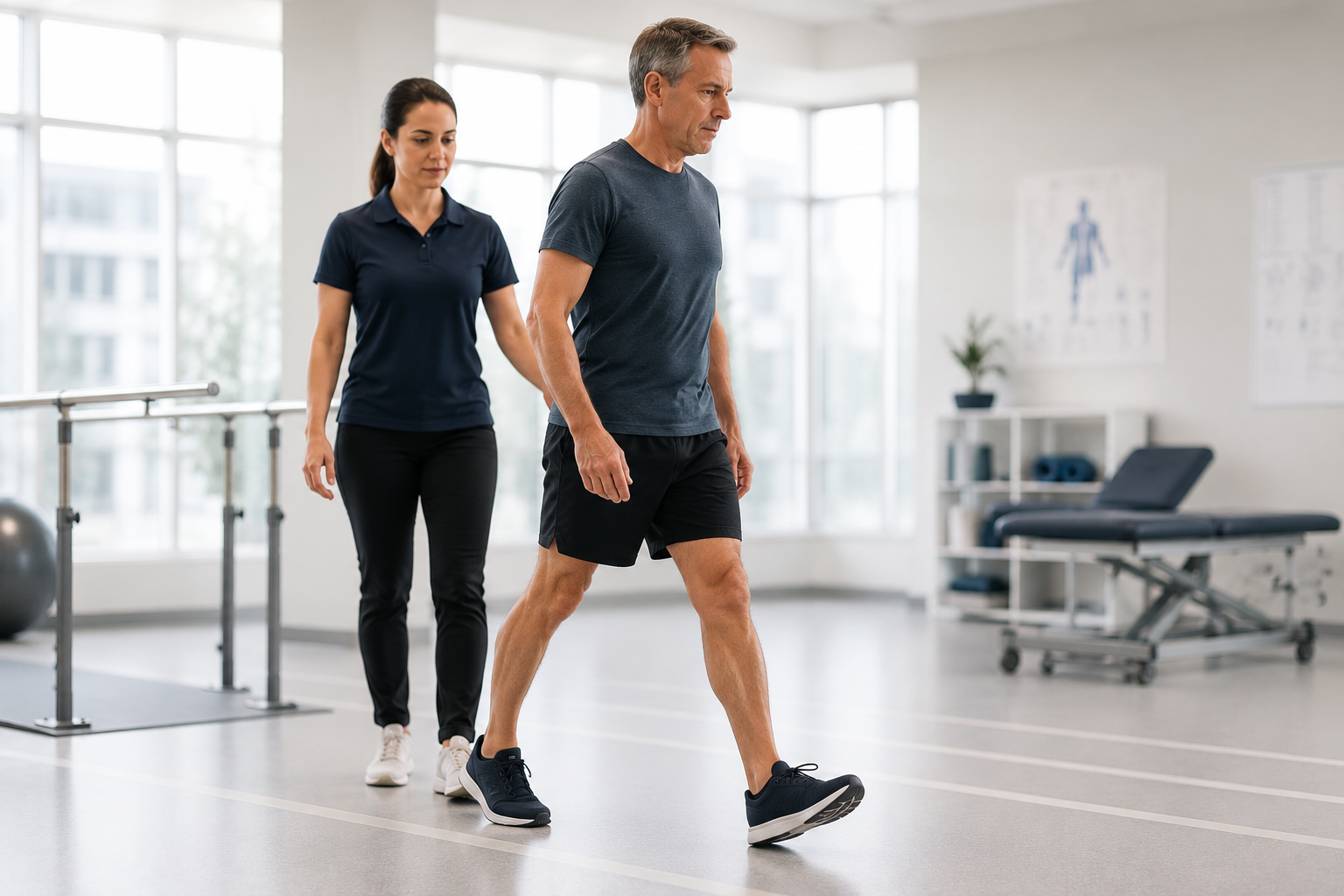
What Is Gait Speed and Why Is It Important?
Gait speed, also called walking speed, describes how quickly a person walks over a given distance. In rehabilitation settings, clinicians may measure it using standardized assessments such as the 10-Meter Walk Test, which is recommended as an outcome measure for adults with neurological conditions when improving walking speed is a rehabilitation goal.
But gait speed does not depend simply on how strong the legs are.
Walking requires the brain, spinal cord, nerves, sensory systems, muscles and joints to work together. Every step involves several coordinated actions: shifting body weight, lifting the foot, moving the leg forward, placing the foot appropriately and preparing the opposite leg for the next step.
A neurological disease or injury can disrupt one or several parts of this process.
As a result, reduced walking speed may be accompanied by:
- Shorter steps
- Difficulty lifting or advancing the affected leg
- Uneven or asymmetrical gait
- Poor coordination
- Balance difficulties
- Muscle weakness
- Increased effort while walking
- Reduced walking endurance
- Fear of falling
This is why clinicians generally look beyond the number itself. The important question is not simply
"How fast is the patient walking?" but also
"What is limiting the patient's ability to walk effectively?"
Which Neurological Conditions Can Affect Walking Speed?
Many neurological conditions can influence gait, although they do so in different ways.
Stroke
Walking impairment is common following stroke. Depending on the area and severity of the brain injury, a person may experience weakness on one side, impaired coordination, altered sensation, balance problems or difficulty controlling the affected leg.
The result may be slower walking speed, shorter steps and gait asymmetry. For many people undergoing stroke rehabilitation, improving walking is therefore an important functional goal.
Parkinson's Disease
Parkinson's disease can change both the rhythm and mechanics of walking. People may develop shorter steps, reduced arm swing, difficulty initiating movement or episodes of freezing. These changes can progressively reduce gait speed and make everyday mobility more challenging.
Multiple Sclerosis
MS can affect walking through several mechanisms, including muscle weakness, spasticity, impaired sensation, balance problems, coordination difficulties and fatigue. Because symptoms vary considerably between individuals, changes in walking speed can also vary over time.
Traumatic Brain Injury
A traumatic brain injury may affect motor control, coordination, balance and sensory processing. When these systems are involved, relearning efficient walking patterns may become part of the rehabilitation process.
Cerebral Palsy
Cerebral palsy can affect muscle tone, coordination, posture and movement patterns. Depending on the individual's functional abilities, gait rehabilitation may focus on improving control, step mechanics, balance and walking efficiency. Despite the differences between these conditions, they share an important rehabilitation challenge:
the nervous system and body must coordinate movement effectively enough to produce functional walking.
Gait Speed Is a Measurement, but Gait Rehabilitation Is the Goal
It can be tempting to think that improving walking speed means simply asking someone to walk faster. Neurological gait rehabilitation is more complex. The objective is generally to address the factors that are limiting walking. Depending on the patient, rehabilitation may involve physical therapy, strengthening, balance training, task-specific walking practice, coordination exercises, sensory training and repeated practice of functional movements.
Repetition is particularly important. The nervous system learns movement through repeated sensory and motor experiences. Following neurological injury or disease, rehabilitation may therefore involve practicing walking patterns again and again while encouraging more appropriate movement.
As movement becomes more controlled and efficient, changes in walking speed may follow. This distinction matters.Walking faster is not necessarily the first goal. Walking better may need to come first.
How Is Walking Speed Measured During Rehabilitation?
One commonly used clinical assessment is the 10-Meter Walk Test (10mWT).
The patient walks over a defined distance while the clinician records the time required. The resulting walking speed is generally expressed in meters per second.
Repeated measurements can help rehabilitation professionals evaluate whether mobility is changing over time. Walking speed, however, is only one part of gait assessment. A therapist may also evaluate balance, step length, symmetry, foot clearance, endurance, coordination, use of assistive devices and the patient's ability to perform everyday mobility tasks.
Two people can therefore have a similar walking speed while experiencing very different gait problems.
That is why rehabilitation should be based on the individual patient's underlying impairment rather than on walking speed alone.
From Therapy Sessions to Real-World Walking Practice
One of the challenges in gait rehabilitation is transferring what happens during therapy into everyday movement.
Patients may practice walking with a physical therapist several times per week, but walking itself is an activity performed throughout daily life.
Depending on the patient's condition and professional recommendations, a rehabilitation program may therefore incorporate structured walking practice outside formal therapy sessions.
The goal is not simply to accumulate steps. It is to provide meaningful opportunities to practice movement patterns while maintaining appropriate safety and technique. This is also where portable gait rehabilitation technologies can play a role.
Just Walk: Supporting Active Gait Rehabilitation
Just Walk™ by Chaban Medical is a wearable neuromotor rehabilitation system designed for people with neurological gait impairments, including individuals recovering from stroke and those living with multiple sclerosis, Parkinson's disease, traumatic brain injury, cerebral palsy and other neurological or orthopedic conditions.
Rather than functioning as a conventional walker that primarily provides external support, Just Walk is designed to participate in the gait cycle itself. The fully mechanical, magnet-driven system assists foot lift at step initiation and applies adjustable resistance as the leg advances.
This creates two complementary elements during walking practice: assistance with part of the gait movement and active resistance that requires the patient to participate in producing the movement. The system is designed to support proprioceptive input, motor learning and functional muscle activation during repeated movement.
Why Is This Different From a Traditional Walking Aid?
A traditional walker, cane or similar mobility aid is generally intended to help a person move more safely or compensate for an existing mobility limitation. Just Walk has a different purpose.
It is designed as a neuromotor rehabilitation device, with the patient actively performing the movement rather than being passively moved through it.
Because the system is wearable and portable, gait practice can also extend beyond specialized rehabilitation equipment. Depending on the individual's abilities and rehabilitation plan, it can be incorporated into activities such as walking, stair climbing, lateral movement and other functional exercises.
This makes the distinction particularly important:
Just Walk is not designed simply to make someone walk faster. It is designed to support the rehabilitation of the neuromotor processes involved in walking.
For someone whose walking speed has declined following a neurological disease or injury, gait speed can therefore serve as one useful measure of progress, while improving functional gait remains the broader rehabilitation objective.
Learn more about Just Walk™ and neuromotor gait rehabilitation.
What Should Patients and Caregivers Focus on?
When walking becomes slower after a neurological condition, speed should not be considered in isolation.
Patients and caregivers can discuss several questions with the rehabilitation team:
- What is causing the change in walking?
- Is weakness, balance, sensation, coordination or motor control the primary limitation?
- Has gait speed been measured objectively?
- Is the walking pattern changing during rehabilitation?
- How much walking practice is appropriate?
- Can rehabilitation safely continue at home?
- Could a gait rehabilitation device support additional functional practice?
The answers will differ considerably between patients. A person recovering from stroke may have very different gait rehabilitation needs from someone with
Parkinson's disease or MS, even when all three demonstrate reduced walking speed.
Taking the Next Step in Gait Rehabilitation
Reduced gait speed after neurological disease can be an important sign of impaired functional mobility, but the number itself tells only part of the story. Effective rehabilitation focuses on the movement behind that number: how the foot lifts, how the leg advances, how weight shifts from one side to the other, how balance is maintained and how the nervous system coordinates each successive step.
For patients who are able to participate in active gait rehabilitation, repeated functional walking practice can become an important component of the rehabilitation journey.
Just Walk™ provides a portable approach designed specifically for this type of active neuromotor retraining, allowing gait practice to extend from the rehabilitation setting into everyday environments.
Talk with your physician or rehabilitation professional about your gait limitations and whether Just Walk is appropriate for your individual rehabilitation program.
FAQ
?What is gait speed
Gait speed is the rate at which a person walks over a measured distance, usually expressed in meters per second. Rehabilitation professionals may use it as one measure of functional mobility and rehabilitation progress.
?Why does walking speed decrease after a stroke
Stroke can affect strength, sensation, balance, coordination and motor control. These changes may make it harder to lift or advance the affected leg and coordinate an efficient gait pattern, resulting in slower or asymmetrical walking.
?Which neurological diseases can affect walking speed
Stroke, Parkinson's disease, multiple sclerosis, traumatic brain injury and cerebral palsy are among the neurological conditions that can affect gait. The mechanism and severity of walking impairment vary from person to person.
?Can gait rehabilitation improve walking speed
Gait rehabilitation may improve different aspects of walking, and walking speed can be one measure used to track change. The appropriate rehabilitation strategy depends on the cause of the gait impairment, the patient's functional ability and individualized rehabilitation goals.
Sources & References
- Academy of Neurologic Physical Therapy / Journal of Neurologic Physical Therapy. A Core Set of Outcome Measures for Adults With Neurologic Conditions Undergoing Rehabilitation. The clinical practice guideline recommends the 10-Meter Walk Test for assessing walking speed in appropriate adults with neurological conditions.
- Pau M, et al. Mobility Disorders in Stroke, Parkinson Disease, and Multiple Sclerosis: A Multicenter Cross-Sectional Study. American Journal of Physical Medicine & Rehabilitation. The study evaluated gait speed, balance and mobility among people with stroke, Parkinson's disease and multiple sclerosis.
- Chaban Medical. Just Walk: Walking Rehabilitation Device. Product information and clinical applications for neurological and orthopedic gait rehabilitation.
Important
This article is for informational purposes only and is not a substitute for professional medical advice; always consult your doctor or physical therapist before starting any exercise or using any device