


6 Minute Walk Test: What It Measures and Why It Matters
Walking is one of the most important indicators of independence and quality of life. Whether recovering from a stroke, managing Parkinson's disease, or rehabilitating after joint replacement surgery, the ability to walk safely and efficiently affects nearly every aspect of daily living.
Healthcare professionals need reliable ways to measure walking ability beyond simply asking patients how they feel. One of the most trusted functional mobility assessments is the 6 Minute Walk Test (6MWT). This simple test provides valuable information about endurance, mobility, and rehabilitation progress, helping clinicians make informed treatment decisions and monitor recovery over time.
In this article, we'll explain what the 6 Minute Walk Test measures, who benefits from it, how results are interpreted, and how targeted rehabilitation including prescription technologies like
Just Walk™
can support walking recovery.
What Is the 6 Minute Walk Test?
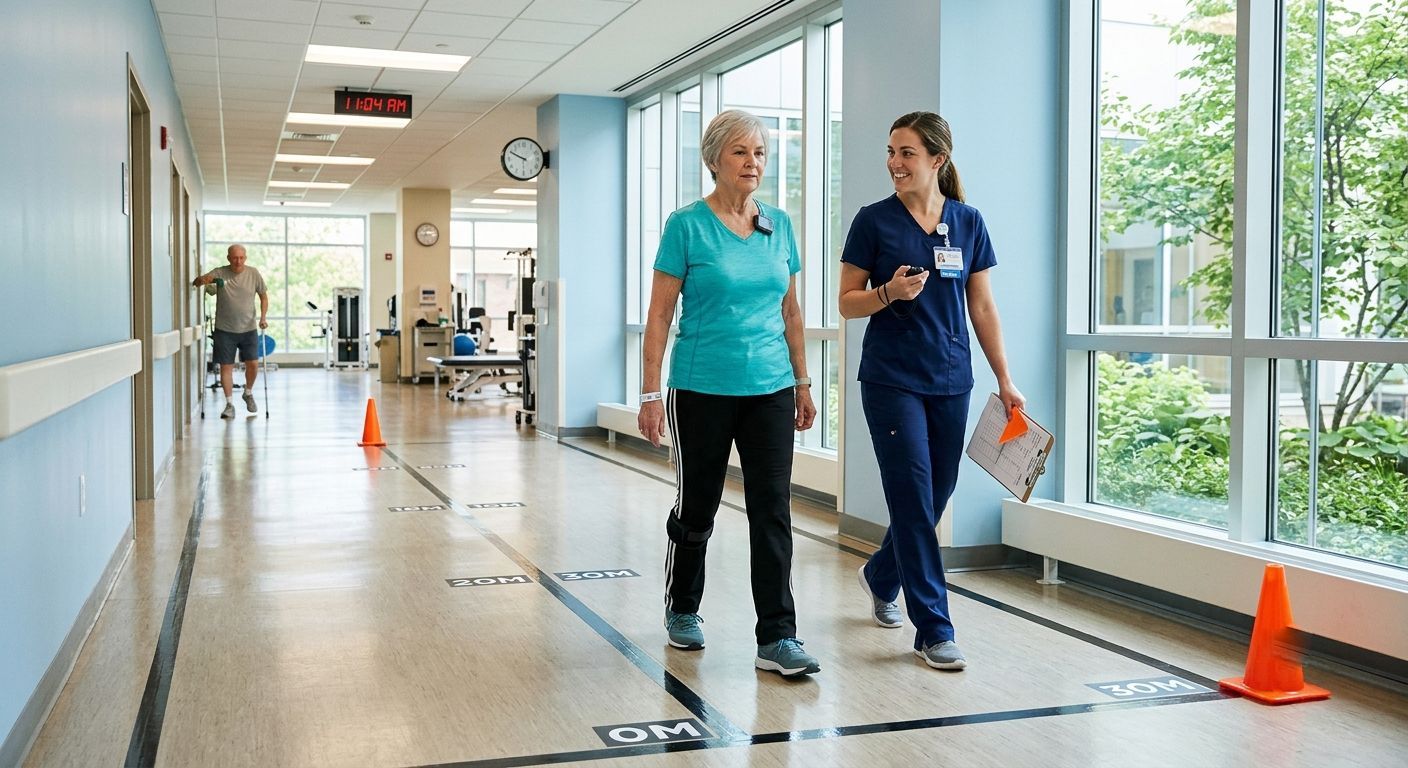
The 6 Minute Walk Test (6MWT) is a standardized functional walking assessment used to measure the distance a person can walk on a flat surface in six minutes.
Unlike treadmill stress tests or high-intensity exercise evaluations, the 6MWT reflects how well someone performs everyday walking activities. Patients are instructed to walk at their own pace while attempting to cover as much distance as possible within six minutes. They may slow down or rest if necessary before continuing.
Because the test closely resembles real-world walking, it has become one of the most widely used outcome measures in rehabilitation medicine.
The results help healthcare providers evaluate:
- Functional walking capacity
- Walking endurance
- Mobility limitations
- Response to rehabilitation
- Progress over time
- Overall functional independence
What Does the 6 Minute Walk Test Measure?
Although the test appears straightforward, it provides insight into several important aspects of physical function.
Walking Endurance
The primary outcome is the total distance walked in six minutes. This reflects how long a person can sustain walking without excessive fatigue or significant limitations.
Reduced walking endurance may affect activities such as shopping, visiting family, or simply walking around the neighborhood.
Functional Mobility
The test evaluates how well a person moves in real-life situations rather than under laboratory conditions.
Walking ability influences everyday tasks including:
- Going to medical appointments
- Returning to work
- Community mobility
- Household activities
- Independent living
Cardiovascular Response
For many patients, the test helps clinicians understand how the heart responds to physical activity.
Heart rate, blood pressure, and symptoms may be monitored before and after the test, particularly in individuals participating in cardiac rehabilitation.
Respiratory Function
People living with chronic lung diseases such as COPD often experience shortness of breath during physical activity.
The 6MWT helps determine how respiratory limitations affect daily walking and provides a practical way to monitor improvement during pulmonary rehabilitation.
Neurological Recovery
Neurological conditions often change the way people walk.
The test allows rehabilitation teams to evaluate how neurological impairments affect endurance, balance, coordination, and functional mobility over time.
Rehabilitation Progress
One of the greatest strengths of the 6 Minute Walk Test is its ability to objectively measure improvement.
Many rehabilitation programs perform the test:
- At the initial evaluation
- During treatment
- At discharge
- During follow-up visits
Comparing results helps clinicians determine whether rehabilitation strategies are improving walking function.
Who Uses the 6 Minute Walk Test?
The 6MWT is used across many medical specialties because walking ability is an important indicator of functional health.
Stroke Survivors
Stroke often affects strength, balance, coordination, endurance, and walking efficiency.
Many stroke survivors experience slower walking speeds and fatigue long before they reach their previous activity levels.
The 6MWT helps rehabilitation teams monitor recovery, evaluate functional walking ability, and guide treatment decisions throughout rehabilitation. Read More Here
People with Parkinson's Disease
Parkinson's disease can cause reduced stride length, slower walking speed, freezing of gait, and fatigue.
The 6MWT helps clinicians assess how these symptoms affect everyday mobility and whether rehabilitation interventions are helping maintain or improve walking function. Read More Here
People with Multiple Sclerosis
Multiple sclerosis (MS) frequently causes fatigue, muscle weakness, impaired balance, and mobility limitations.
Because symptoms may fluctuate, repeating the 6MWT over time provides valuable information about changes in walking capacity and rehabilitation outcomes. Read More Here
People Recovering from Hip or Knee Replacement
Joint replacement surgery aims to restore mobility and independence.
The 6MWT helps healthcare providers measure functional recovery beyond pain relief or range of motion, showing how comfortably patients can return to everyday walking activities.
People with COPD
For individuals living with chronic obstructive pulmonary disease (COPD), walking often becomes increasingly difficult due to reduced lung function. The 6MWT is a standard assessment used during pulmonary rehabilitation to evaluate exercise tolerance and monitor improvement.
People Participating in Cardiac Rehabilitation
After heart surgery, heart attacks, or other cardiovascular conditions, patients often participate in structured cardiac rehabilitation.
The 6MWT helps clinicians safely assess functional capacity while monitoring recovery throughout rehabilitation.
Physical Therapists
Physical therapists use the test to:
- Establish a baseline
- Develop rehabilitation goals
- Monitor patient progress
- Adjust treatment plans
- Measure functional outcomes
Because the test is standardized, it provides objective information that can be compared over time.
Occupational Therapists
Occupational therapists focus on helping individuals regain independence in daily activities.
The 6MWT provides useful information about a patient's ability to safely navigate home and community environments while performing everyday tasks.
Rehabilitation Physicians
Physiatrists and rehabilitation physicians use the test as one component of a comprehensive rehabilitation assessment.
The results help evaluate recovery, identify mobility limitations, and guide rehabilitation planning across neurological, orthopedic, pulmonary, and cardiac conditions.
When Does the Test Signal a Mobility Problem?
The distance covered during the 6 Minute Walk Test is only one part of the overall assessment.
Healthcare professionals also consider:
- Age
- Sex
- Height
- Weight
- Medical diagnosis
- Symptoms during walking
- Rehabilitation goals
A lower-than-expected walking distance does not automatically indicate a serious problem, but it may suggest that additional evaluation or rehabilitation is needed.
Other findings that may indicate mobility limitations include:
- Needing frequent rest breaks
- Significant fatigue during the test
- Shortness of breath beyond expected levels
- Unsteady walking or balance difficulties
- Walking pain
- Declining performance over repeated assessments
Because many medical conditions affect walking differently, test results should always be interpreted by a qualified healthcare professional within the context of the individual's overall health.
How Can Mobility Improve After the 6 Minute Walk Test?
The purpose of the 6MWT is not simply to measure walking performance. Its greatest value is identifying opportunities for rehabilitation.
Depending on the underlying condition, rehabilitation may include:
- Gait rehabilitation
- Balance training
- Strengthening exercises
- Functional mobility training
- Neurological rehabilitation
- Orthopedic rehabilitation
- Home-based rehabilitation programs
Consistent, task-specific rehabilitation helps patients gradually restore walking efficiency, endurance, confidence, and independence. Every rehabilitation program should be individualized according to the patient's diagnosis, functional goals, and clinical recommendations.
How Just Walk™ Supports Gait Rehabilitation
For individuals recovering from neurological or orthopedic conditions, improving walking ability often requires repetitive, task-specific gait rehabilitation under the guidance of healthcare professionals.
Just Walk™ is a prescription wearable gait rehabilitation device designed to support this rehabilitation process.
Rather than functioning as a mobility aid or exercise device, Just Walk™ is intended to complement a clinician-directed rehabilitation program by supporting repetitive walking practice focused on restoring more natural gait patterns.
Just Walk™ may be incorporated into rehabilitation programs for appropriate patients recovering from conditions that affect walking, including neurological and orthopedic disorders.
Key features include:
- Designed specifically for gait rehabilitation
- Supports repetitive, task-specific walking practice
- Complements physical therapy and rehabilitation programs
- Can be incorporated into home rehabilitation under professional supervision
- Intended to help restore functional walking and mobility
- Prescription-only medical rehabilitation device
Because every patient's rehabilitation needs are different, healthcare professionals determine whether Just Walk™ is appropriate as part of an individualized rehabilitation plan.
Summary
The 6 Minute Walk Test is one of the most valuable tools for measuring functional walking ability in rehabilitation medicine.
By evaluating walking endurance and mobility, the test helps healthcare professionals assess recovery, monitor progress, and develop personalized rehabilitation plans for people recovering from neurological, orthopedic, pulmonary, and cardiac conditions.
For patients whose walking ability has been affected by injury or disease, structured rehabilitation plays a critical role in restoring independence. Prescription rehabilitation technologies such as Just Walk™ may be incorporated into a comprehensive rehabilitation program to support gait rehabilitation under the guidance of qualified healthcare professionals.
If you or a loved one are experiencing mobility challenges, speak with your rehabilitation provider to learn about rehabilitation options that may be appropriate for your individual needs.
FAQ
?What is a normal 6 Minute Walk Test distance
Normal walking distance varies based on factors such as age, sex, height, weight, and overall health. Healthcare professionals interpret results using established reference values while considering the individual's medical condition and rehabilitation goals.
?Can I stop and rest during the test
Yes. Patients are allowed to slow down or rest if needed. The goal is to measure the total distance walked during the six-minute period under standardized conditions.
?How often should the 6 Minute Walk Test be repeated
The test is commonly repeated throughout rehabilitation to monitor progress and evaluate how well treatment is improving functional walking ability.
?Does a shorter walking distance always mean something is wrong
Not necessarily. Many factors influence walking distance. Results should always be interpreted by a qualified healthcare professional within the context of the patient's diagnosis, symptoms, and overall health.
?Is Just Walk™ available without a prescription
No. Just Walk™ is available by prescription only. It is a prescription rehabilitation device intended for use as part of a clinician-directed rehabilitation program. A qualified healthcare professional determines whether Just Walk™ is appropriate based on the patient's medical condition, rehabilitation goals, and treatment plan.
Sources & References
- American Thoracic Society. ATS Statement: Guidelines for the Six-Minute Walk Test.
- American Physical Therapy Association (APTA). Functional Outcome Measures in Physical Therapy.
- American Heart Association. Cardiac Rehabilitation Guidelines.
- National Institute of Neurological Disorders and Stroke (NINDS). Stroke Rehabilitation Information.
Important
This article is for informational purposes only and is not a substitute for professional medical advice; always consult your doctor or physical therapist before starting any exercise or using any device
Just Walk Official Distributor: +1-914-345-9300 Or +1-800-431-2830 👉 Become a Just Walk Distributor