


What is the Dynamic Gait Index? Fall Risk and Rehab Solutions
Every year, millions of older adults and individuals recovering from neurological conditions experience a quiet but persistent anxiety: the fear of falling. While standing still or walking along a perfectly flat, quiet hallway might feel manageable, real life requires split second physical adaptations.
Turning your head to look at a passing car, stepping over a stray object on the floor, or navigating a flight of stairs all demand complex neurological coordination. When balance and mobility issues arise, clinical teams rely on objective assessments to measure these everyday vulnerabilities.
Chief among these tools is the Dynamic Gait Index (DGI). Understanding what this evaluation entails, and recognizing the early warning signs of gait instability, is the first step toward reclaiming safe, independent movement.
What is the Dynamic Gait Index (DGI)?
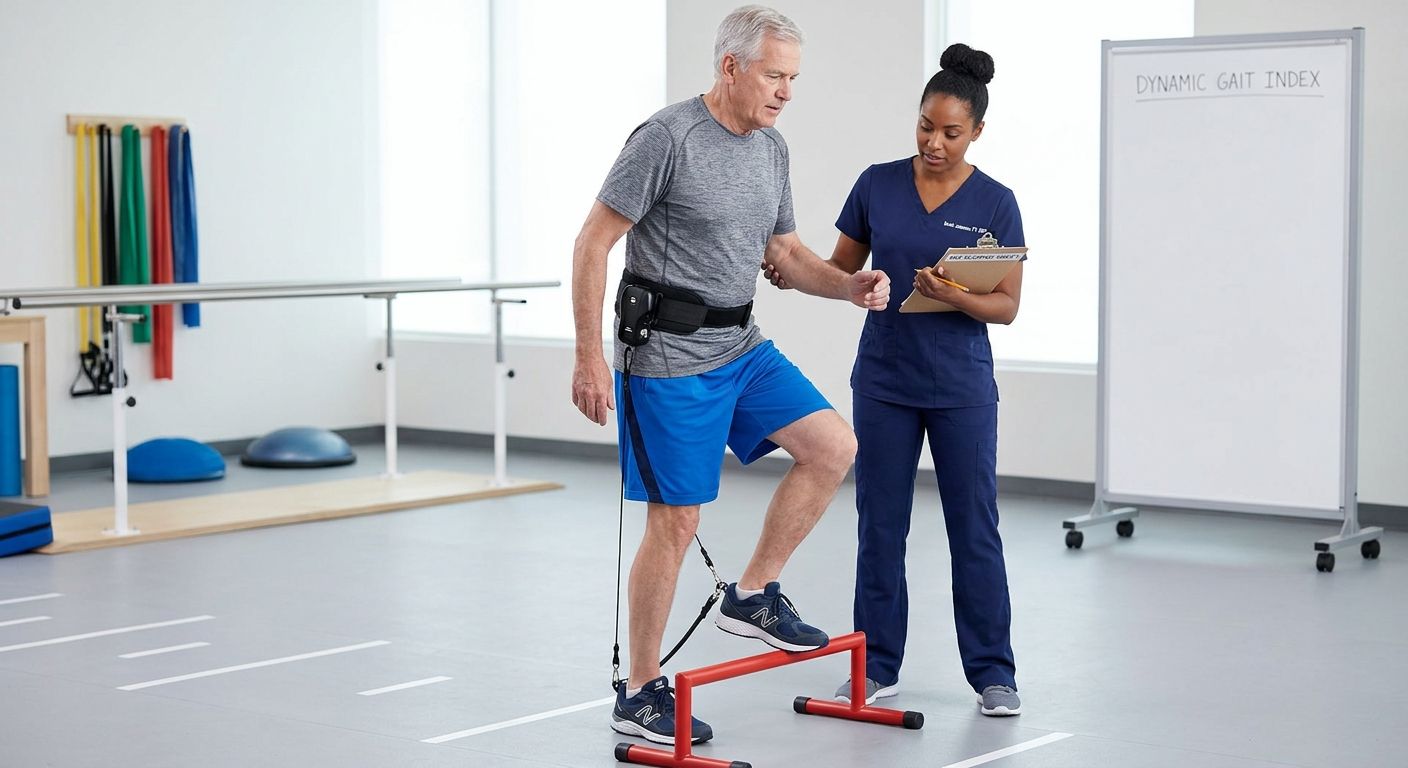
The Dynamic Gait Index (DGI) is a standardized clinical assessment used by physical therapists and neurologists to evaluate a person’s ability to modify their balance while walking under shifting, real world demands. Developed to look beyond simple walking speed, the test scores how effectively the brain, muscles, and inner ear (vestibular system) collaborate during movement.
The assessment takes roughly 15 minutes and is performed in a controlled medical rehabilitation setting, such as a physical therapy clinic or hospital corridor.
A clinician grades the patient on eight specific tasks:
- Steady Walking: Moving 20 feet at a self selected, comfortable pace.
- Changing Gait Speed: Accelerating to a fast walk and decelerating to a slow walk on command.
- Horizontal Head Turns: Walking straight while looking left and right.
- Vertical Head Turns: Walking straight while looking up and down.
- The Quick Pivot Turn: Walking forward, stopping, and turning 180 degrees instantly without losing balance.
- Stepping Over Obstacles: Safely crossing over an object like a shoebox rather than walking around it.
- Stepping Around Obstacles: Navigating a weaving, slalom style path around traffic cones.
- Climbing Stairs: Ascending and descending a flight of stairs, noting the level of reliance on a handrail.
Why the Dynamic Gait Index Matters for Neurological Conditions
For individuals navigating neurological conditions such as a stroke, Parkinson’s disease, Multiple Sclerosis (MS), or Traumatic Brain Injury (TBI), the DGI is an invaluable predictive tool. These conditions frequently disrupt the pathway between the brain and the lower limbs, causing physical impairments like foot drop (the inability to lift the front part of the foot) or asymmetric muscle weakness.
Beyond raw strength deficits, neurological conditions often impair proprioception (the body's sixth sense that allows you to subconsciously perceive where your limbs are positioned in space). Without strong proprioceptive signals, tasks like turning your head while moving or changing directions quickly become major fall risks.
Every task on the DGI is scored from a 0 (severe impairment) to a 3 (normal performance), culminating in a maximum score of 24.
⚠️
The Clinical Cutoff: In physical therapy circles, a total score of
19 or below indicates a significantly elevated risk of sustaining a future fall. For patients with
Multiple Sclerosis, a score of 12 or below serves as the threshold for high fall risk.
Modern Rehabilitation Options for Gait and Balance Issues
When a DGI score indicates a high fall risk, waiting for a fall to happen is not an option. Neurological rehabilitation strategies focus heavily on neuroplasticity (the brain's innate capacity to reorganize itself, form new neural connections, and bypass damaged pathways by repeating targeted movements).
Traditional physical therapy approaches include:
- Perturbation Training: Practicing recovering from unexpected nudges or surface changes.
- Functional Mobility Drills: Weaving through obstacles and stepping over items to mimic home environments.
- Strength and Range of Motion Exercises: Strengthening the hip flexors and ankles to combat foot drop.
While these strategies are effective, standard clinical sessions are often limited by time, and translating these skills into daily at home rehabilitation strategies can be difficult without the right tools.
Meeting Just Walk™: The Solution to Balance Disruption
To actively bridge the gap between clinical evaluation and real world recovery, patients are turning to innovative wearable technologies. This is where individuals struggling with a low DGI score can benefit from meeting Just Walk™, an advanced gait rehabilitation device manufactured by Chaban Medical.
Just Walk™ directly targets the exact mobility deficits highlighted by the Dynamic Gait Index. It is an entirely mechanical, non motorized wearable unit that attaches to a comfortable hip belt. A specialized dynamic tension cord extends down from the hip mechanism and clips directly to the patient's shoe or ankle strap.
As the patient moves forward, an internal magnetic field mechanism generates smooth, speed adaptive linear resistance during the swing phase of walking. This unique interaction forces the muscles to engage deliberately, sending powerful sensorimotor feedback back to the central nervous system to accelerate neuroplastic recovery.
Product Differentiation: Why Just Walk™ Stands Out
In the landscape of walking rehabilitation devices, Just Walk™ offers unique practical benefits that set it apart from traditional clinical alternatives:
- Speed Adaptive Magnetic Resistance: Unlike heavy robotic exoskeletons that move the patient's limbs automatically, Just Walk™ relies entirely on the user's active effort. The faster the patient tries to step, the more resistance the device provides. This builds true muscular power and coordination without loading heavy weights onto vulnerable joints.
- Active Assistance for Foot Drop: The upward tension vector of the cord acts as a supportive mechanical lift. At step initiation, it helps the patient flex the knee and lift the foot, directly addressing the underlying impairments that cause individuals to trip during the obstacle crossing tasks of the DGI.
- Restoring Walking Symmetry: Neurological conditions often cause patients to heavily favor their unaffected side. Because Just Walk™ features four adjustable resistance levels, physical therapists can customize the settings to challenge the dominant leg or strengthen the weaker limb, restoring symmetrical balance.
- True Functional Portability: Weighing just 3.3 lbs (1.5 kg) and requiring zero electricity or battery charging, it eliminates the restrictions of tethered hospital equipment. Patients can safely wear the device while practicing dynamic real world movements (such as climbing real stairs or pivoting in their own living rooms) making it the ultimate tool for at home rehabilitation strategies.
Learn more about the Just Walk System
and how it supports evidence-based gait rehabilitation
Summary
The Dynamic Gait Index is a powerful radar system that detects balance vulnerabilities before they result in injury. However, identifying a low score is only the first half of the equation. By pairing standard objective testing with neuroplasticity driven tools like Just Walk™, patients, caregivers, and medical professionals have a clear, proactive path to mitigate fall risks, rebuild natural gait mechanics, and step forward into a more independent life.
If you or a loved one are concerned about mobility deficits, consult your physical therapist about incorporating DGI tracking and wearable gait technologies into your care plan.
FAQ
?Can I perform the Dynamic Gait Index test at home by myself
The DGI should be administered by a trained healthcare professional, such as a physical therapist. Clinicians are trained to spot subtle balance compensations and ensure your physical safety if you lose your balance during the challenging components of the test, such as the pivot turns.
?Does the Just Walk™ device require a prescription
Yes, Just Walk™ is an FDA cleared and CE marked medical rehabilitation device. It is available only upon receiving a direct medical referral from a Doctor or Orthopedist. Once referred, it is highly recommended to integrate the device under the guidance of a physical therapist to optimize the personal resistance settings for your specific rehabilitation needs.
?How often should someone use Just Walk™ to see improvements in their balance
Clinical protocols vary depending on whether a patient is recovering from a stroke, managing MS, or dealing with age related balance issues. However, many standard programs involve short, high quality training blocks of 10 to 15 minutes a day, several times a week, to stimulate neural adaptation without causing muscle fatigue.
Sources & References
Academy of Neurologic Physical Therapy (ANPT): Clinical Practice Guideline for the Use of Core Outcome Measures in Neurologic Rehabilitation, Dynamic Gait Index.
Rehabilitation Measures Database (Shirley Ryan AbilityLab): Dynamic Gait Index Clinical Review, Validity, and Reliability Coefficients across Neurological Populations.
Important
This article is for informational purposes only and is not a substitute for professional medical advice; always consult your doctor or physical therapist before starting any exercise or using any device
Just Walk Official Distributor: +1-914-345-9300 Or +1-800-431-2830 👉 Become a Just Walk Distributor