


10-Meter Walk Test: Instructions, Scoring, Norms & Calculator
What Is the 10-Meter Walk Test?
The 10-Meter Walk Test, also called the 10MWT, measures how quickly a person can walk over a defined distance.
Depending on the clinical protocol, the test may assess:
- Comfortable or usual walking speed
- Fast or maximum safe walking speed
The 10MWT is used in rehabilitation and research involving a variety of populations, including people with neurological and musculoskeletal conditions. One of its main advantages is its simplicity. Because walking speed can be measured objectively, clinicians can repeat the assessment and compare results over time.
Why Do Physical Therapists Use the 10MWT?
Physical therapists may use the 10MWT to establish a baseline and monitor changes in walking performance during rehabilitation.
For example, a therapist may perform the test at the beginning of a rehabilitation program and repeat it several weeks later.
The comparison can help answer questions such as:
- Has walking speed changed?
- Is the patient making measurable progress?
- Has functional mobility improved?
- Is the patient's response to rehabilitation consistent with other functional changes?
The test is therefore particularly useful as a repeated outcome measure rather than as a one-time measurement.
The 10MWT should not, however, be viewed as a complete assessment of gait. Walking speed is only one aspect of mobility, and clinicians may also assess balance, endurance, strength, coordination, gait symmetry, foot clearance and other factors.
How to Perform the 10-Meter Walk Test
10-Meter Walk Test Instructions
The exact procedure can vary depending on the protocol being used.
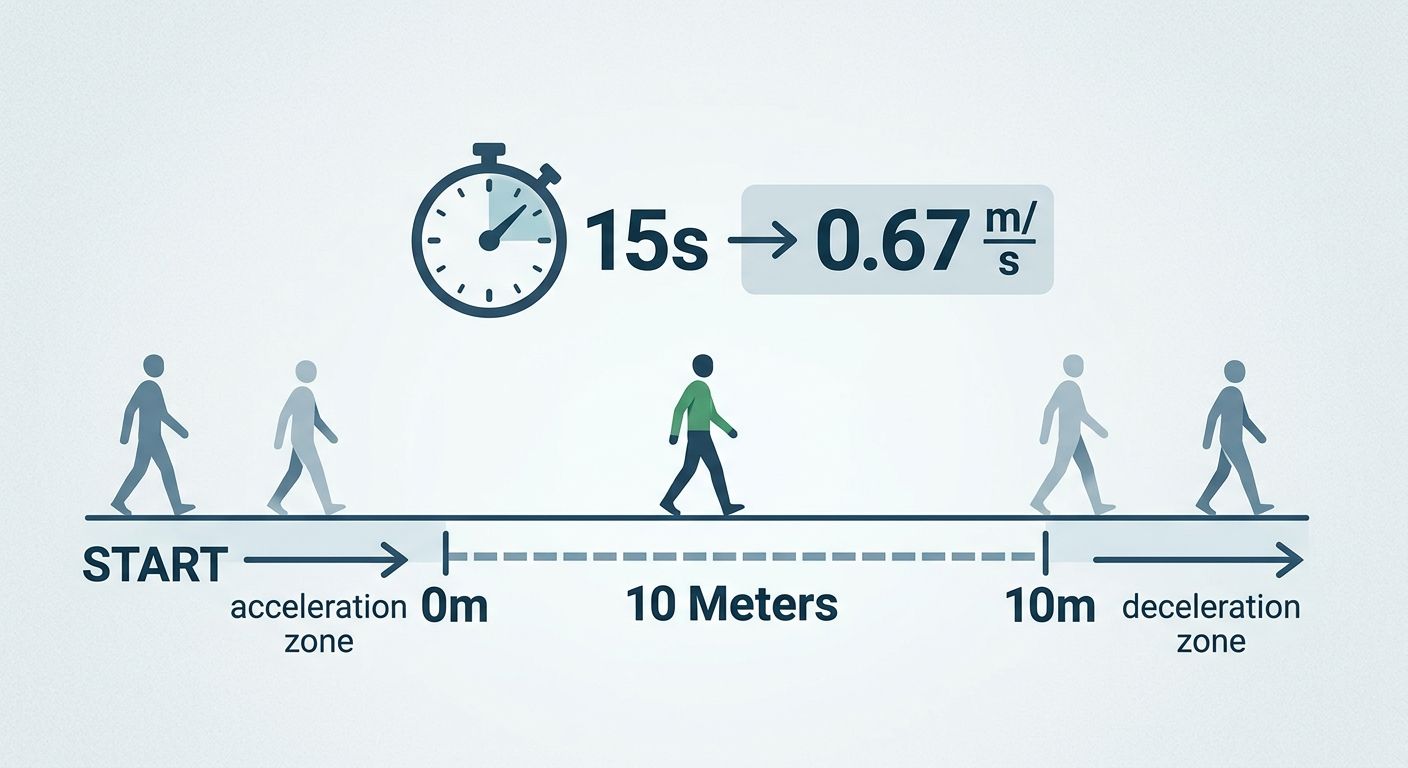
A typical setup includes a straight, unobstructed walking path with a defined timed distance. Additional space may be provided before and after the timed section so the person can accelerate and decelerate naturally.
The clinician generally:
- Explains the test and provides the appropriate walking instructions.
- Positions the patient at the starting point.
- Instructs the patient to walk at the requested pace.
- Starts timing according to the selected protocol.
- Stops timing when the patient reaches the end of the timed distance.
- Records the result.
- Repeats the trial when required by the protocol.
The person may be tested at their usual/comfortable
walking speed and, when appropriate and safe, at their fastest safe walking speed.
10MWT Protocol
There is no single protocol that is used identically in every clinical environment. Published studies have used variations in walkway length, acceleration distance, timing procedures, number of trials and walking instructions.
For this reason, clinicians should follow the protocol appropriate to their clinical or research setting.
When the 10MWT is being used to monitor progress, consistency is particularly important. The clinician should document relevant testing conditions and attempt to reproduce them during subsequent assessments.
10-Meter Walk Test Calculator
The basic calculation is straightforward:
Walking speed (m/s) = distance (m) ÷ time (seconds)
For a 10-meter test:
| Time to walk 10 meters | Time to complete 10 meters |
|---|---|
| 5 seconds | 2.00 m/s |
| 8 seconds | 1.25 m/s |
| 10 seconds | 1.00 m/s |
| 12 seconds | 0.83 m/s |
| 15 seconds | 0.67 m/s |
| 20 seconds | 0.50 m/s |
| 25 seconds | 0.40 m/s |
A calculator can make this conversion easier, particularly when clinicians or patients want to quickly convert a recorded time into meters per second. However, the calculation itself should not be confused with clinical interpretation. The resulting number needs to be considered alongside the person's diagnosis, functional ability, testing conditions and rehabilitation goals.
10-Meter Walk Test Scoring and Interpretation
The primary outcome of the 10MWT is walking speed, expressed in meters per second.
A higher walking speed generally means that the person completed the timed distance more quickly. However, there is no single score that can be considered "good" or "normal" for everyone.
Interpretation may depend on:
- Age
- Medical condition
- Functional ability
- Walking environment
- Assistive-device use
- Whether the test was performed at a comfortable or fast pace
- The specific testing protocol
- The person's previous results
For rehabilitation professionals, changes over time can be particularly informative. For example, if a patient previously walked at 0.50 m/s and later walks at 0.65 m/s under comparable testing conditions, the change may indicate improved walking performance. Whether that change is clinically meaningful requires consideration of the relevant population and measurement research.
10-Meter Walk Test Norms
There is no universal 10MWT score that applies to every individual. Walking speed varies considerably among healthy people and can be influenced by age, physical characteristics, fitness, health status and other factors. Normative data can therefore be useful as a reference, but they should not be treated as a diagnostic standard or a simple pass/fail test. For rehabilitation, a patient's own previous performance can often provide particularly useful information.
10-Meter Walk Test Norms by Age
Walking speed generally changes with age, which is why researchers have developed age-related reference values for gait speed.
However, age alone does not determine what an individual's walking speed should be. When interpreting
10 meter walk test norms by age, clinicians should consider the characteristics of the population from which the reference data were obtained and whether the testing protocol is comparable.
10-Meter Walk Test and Fall Risk
Walking speed can provide useful information about functional mobility, but the 10-Meter Walk Test should not be used by itself to determine fall risk.
Falls can result from multiple factors, including:
- Balance impairment
- Muscle weakness
- Vision problems
- Sensory impairment
- Medication effects
- Environmental hazards
- Previous falls
- Cognitive or attention-related factors
- Gait abnormalities
A rehabilitation professional may therefore combine the 10MWT with other assessments when evaluating mobility and fall risk.
10MWT After Stroke
The 10-Meter Walk Test is frequently used in stroke rehabilitation to measure walking speed. A stroke can affect walking in different ways, and walking speed may change as a person's functional abilities change during rehabilitation. The 10MWT can provide an objective measurement that allows clinicians to compare walking performance at different stages of recovery.
Importantly, the test measures walking speed rather than every component of gait. A person may have improvements in walking speed while continuing to experience difficulties with balance, symmetry, endurance or other aspects of mobility.
10MWT and Parkinson's Disease
The 10MWT is also used to assess walking performance in people with Parkinson's disease. Depending on the individual's symptoms, clinicians may be interested in comfortable walking speed, faster walking performance, or changes in walking speed over time.
Because Parkinson's disease can affect several aspects of gait, the 10MWT is generally used alongside other clinical assessments rather than as a complete measure of walking function.
What Is a Clinically Meaningful Change in the 10MWT?
A change in walking speed is not automatically clinically meaningful simply because the number has increased.
The Minimal Clinically Important Difference (MCID) refers to a change considered meaningful within a particular patient population and clinical context.
Importantly, there is not necessarily one MCID that applies to every condition. Different studies have reported different meaningful-change values depending on the population, study design and outcome being examined. For example, research in stroke rehabilitation has reported several estimates of meaningful change in gait speed.
This is why clinicians should use population-specific evidence when determining whether a change in 10MWT performance represents an important improvement.
Using the 10MWT to Track Rehabilitation Progress
One of the most useful applications of the 10MWT is monitoring change over time.
A clinician can establish a baseline measurement and repeat the assessment later under comparable conditions.
The results can then be considered alongside other measures of functional performance.
For example: Initial assessment → rehabilitation → repeat 10MWT → compare results
If walking speed changes, the clinician can investigate what may have contributed to that change and whether it corresponds with improvements in other aspects of mobility. The 10MWT can therefore provide an objective piece of information within a broader rehabilitation program.
The 10-Meter Walk Test is an assessment tool, not a treatment.
Its role is to measure walking performance. What happens after the assessment depends on the individual's specific rehabilitation needs.
If impaired walking is related to neurological or musculoskeletal limitations, a rehabilitation program may address factors such as:
- Motor control
- Balance
- Coordination
- Strength
- Foot clearance
- Weight shifting
- Gait mechanics
- Repeated functional walking practice
This creates an important distinction:
The 10MWT measures walking performance. Gait rehabilitation works toward improving walking function.
How Just Walk Fits Into Gait Rehabilitation
Just Walk™ by Chaban Medical is a wearable neuromotor rehabilitation device designed to support active gait rehabilitation.
It is not a cane, walker or conventional mobility aid. Instead, it is designed to be used as part of active movement practice, with mechanical assistance and adjustable resistance incorporated into the walking movement.
For an individual participating in a rehabilitation program, an assessment such as the 10MWT can help a clinician quantify walking performance, while an appropriate rehabilitation intervention can address the movement limitations contributing to impaired gait.
The two therefore serve different purposes:
10MWT → measures walking speed
Gait rehabilitation → works to improve walking ability
Just Walk → can be incorporated into an appropriate active neuromotor gait-rehabilitation program
Just Walk should be used according to professional recommendations and the individual's rehabilitation needs.
Learn more about Just Walk™ and neuromotor gait rehabilitation.
Summary
The 10-Meter Walk Test (10MWT) provides a simple way to objectively measure walking speed. Physical therapists and other rehabilitation professionals can use it to establish a baseline, monitor changes and evaluate walking performance over time.
The test involves more than simply recording how long someone takes to walk 10 meters. The testing protocol, walking speed instructions, assistive-device use and clinical context can all affect how the result should be interpreted.
For patients undergoing rehabilitation, the 10MWT can help quantify one aspect of walking ability. It does not, however, measure every component of gait or replace a comprehensive clinical assessment.
When appropriate, gait rehabilitation interventions such as Just Walk may be incorporated into a broader rehabilitation plan focused on active neuromotor training and functional walking.
FAQ
?What does the 10-Meter Walk Test measure
The 10-Meter Walk Test measures walking speed over a defined distance. The result is generally expressed in meters per second.
?How do you calculate the 10-Meter Walk Test
Walking speed is calculated by dividing the distance by the time required to walk that distance. For a 10-meter timed distance, divide 10 by the recorded time in seconds.
?What is a normal 10-Meter Walk Test score
There is no single score that is normal for everyone. Interpretation depends on factors such as age, health status, functional ability and the testing protocol.
?Is the 10-Meter Walk Test used after stroke
Yes. The 10MWT is commonly used in stroke rehabilitation to measure walking speed and monitor changes in walking performance.
?Can the 10MWT be used for Parkinson's disease
Yes. The test can be used to measure walking speed in people with Parkinson's disease, although it should generally be considered alongside other assessments of gait and mobility.
?Can the 10-Meter Walk Test predict falls
The test can provide information about walking performance, but it should not be used alone to determine an individual's fall risk. Fall risk is influenced by multiple factors.
Sources & References
- Shirley Ryan AbilityLab. 10 Meter Walk Test (10MWT). RehabMeasures Database. https://www.sralab.org/rehabilitation-measures/10-meter-walk-test
- Fritz S, Lusardi M. White paper: "Walking speed: the sixth vital sign." Journal of Geriatric Physical Therapy.
- Short-distance walking speed tests in people with Parkinson disease: reliability, responsiveness, and validity. Gait & Posture. https://pubmed.ncbi.nlm.nih.gov/24246801/
- Distance-limited walk tests post-stroke: a systematic review. https://pubmed.ncbi.nlm.nih.gov/33967070/
- Walking speed at the acute and subacute stroke stage: A descriptive meta analysis. https://pubmed.ncbi.nlm.nih.gov/36226075/
Important
This article is for informational purposes only and is not a substitute for professional medical advice; always consult your doctor or physical therapist before starting any exercise or using any device
Just Walk Official Distributor: +1-914-345-9300 Or +1-800-431-2830 👉 Become a Just Walk Distributor