


Double Support Time: What It Means and Why It Changes After Stroke or Parkinson's
If you've recently undergone a gait analysis, you may have noticed a term called double support time or double support percentage. Seeing that this value is higher than normal can be confusing, especially if you're recovering from a stroke, living with Parkinson's disease, or another neurological condition.
The good news is that increased double support time is not a diagnosis by itself. Instead, it provides valuable information about your walking stability and balance. Understanding what this measurement means can help you track your progress and choose rehabilitation strategies that support safer, more confident walking.
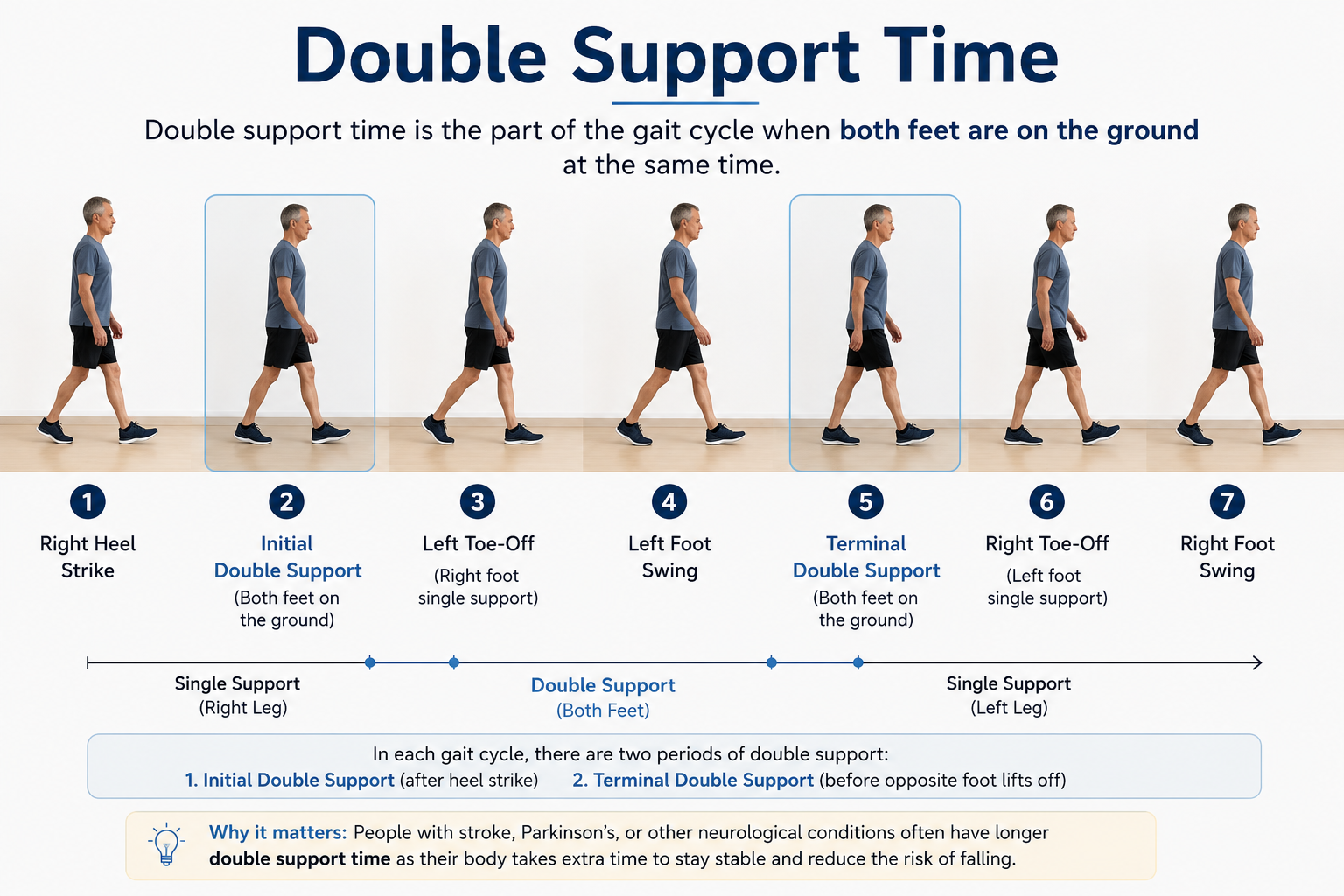
What Is Double Support Time?
Double support time is the portion of the gait cycle when both feet are on the ground at the same time.
During a normal walking cycle, there are two brief periods when your body transfers weight from one leg to the other. These moments are called the double support phases. The measurement is commonly reported during gait analysis because it reflects how stable a person feels while walking.
What Is a Normal Double Support Time?
A healthy adult typically spends approximately 20% of the gait cycle in double support, with about 10% occurring during each transition between legs.
This value changes depending on:
- Walking speed
- Age
- Overall balance
- Muscle strength
- Neurological function
As walking speed increases, double support time naturally becomes shorter. During running, double support disappears completely because neither foot touches the ground simultaneously.
Why Is My Double Support Time High?
One of the most common questions after receiving a gait analysis report is:
When Does the Test Signal a Mobility Problem?
An increased double support time usually means your body is spending more time with both feet on the ground to improve stability. This often happens because the brain is subconsciously trying to reduce the risk of falling.
Common causes include:
- Stroke
- Parkinson's disease
- Multiple sclerosis
- Peripheral neuropathy
- Vestibular disorders
- Balance impairments
- Muscle weakness
- Fear of falling
It's important to understand that this is often a
compensatory strategy, not necessarily a problem by itself.
Double Support Time After Stroke
After a stroke, communication between the brain and muscles changes.
Many stroke survivors:
- walk more slowly
- hesitate before transferring weight
- rely more heavily on the stronger leg
- increase double support time to improve stability
While this helps
reduce falls in the early stages of recovery, rehabilitation often focuses on gradually improving balance,
symmetry, and confidence so walking becomes more efficient.
Double Support Time in Parkinson's Disease
People living with Parkinson's disease frequently experience changes in gait, including:
- shorter steps
- slower walking speed
- shuffling gait
- reduced arm swing
- freezing episodes
These changes often lead to increased double support time because maintaining stability becomes more challenging.
A comprehensive rehabilitation program can help improve walking mechanics and mobility while reducing fall risk.
Can Double Support Time Improve?
Yes.
The goal is not simply to reduce double support time, but to improve the balance, coordination, and confidence that allow it to normalize naturally.
Effective rehabilitation may include:
- balance training
- gait training
- task-specific walking practice
- visual feedback
- repetitive walking exercises
- strength training
- home rehabilitation
As walking becomes more stable, many patients naturally reduce the amount of time spent in double support.
How Just Walk Helps Improve Walking Stability
Recovering from neurological conditions requires more than simply walking more often.
The nervous system improves through repetitive, task-specific practice combined with objective feedback.
Just Walk is designed specifically to support walking rehabilitation by providing real-time gait analysis and meaningful performance metrics that patients and clinicians can track over time.
Unlike traditional walking exercises that rely primarily on observation, Just Walk helps quantify important gait parameters, including those related to walking symmetry, balance, and stability.
Benefits of Just Walk include:
- Objective gait measurements
- Progress tracking across rehabilitation sessions
- Immediate performance feedback
- Home-based rehabilitation between therapy visits
- Increased patient motivation
- Clinician-friendly outcome measures
- Safe, repetitive walking practice
Whether recovering from a stroke, managing Parkinson's disease, or rehabilitating another neurological condition, consistent gait practice supported by measurable data can help improve confidence and functional mobility.
Learn more about Just Walk -
Click Here
Why Monitoring Double Support Time Matters
Double support time is one of several valuable indicators used during gait analysis.
When monitored together with walking speed, step length, cadence, and symmetry, it provides clinicians with a clearer understanding of recovery progress. Rather than focusing on a single number, healthcare providers evaluate the overall walking pattern to guide rehabilitation decisions.
Summary
Double support time reflects how long both feet remain on the ground during walking.
After stroke, Parkinson's disease, and other neurological conditions, an increased double support time is common because the body naturally prioritizes stability.
With appropriate gait rehabilitation and consistent practice, many individuals can improve balance, walking confidence, and overall mobility. Technologies such as
Just Walk provide objective measurements that help patients and clinicians monitor progress and support evidence-based rehabilitation.
FAQ
?Is increased double support time always a bad sign
Not necessarily. It often reflects the body's natural strategy to improve stability and reduce fall risk.
?Can double support time improve after stroke
Yes. Many stroke survivors reduce double support time as balance, strength, and confidence improve through rehabilitation.
?Does Parkinson's disease increase double support time
Yes. Parkinson's disease commonly affects gait and balance, often leading to longer periods of double support during walking.
?How is double support time measured
It is measured during gait analysis using wearable sensors, pressure-sensitive walkways, motion capture systems, or other digital gait assessment technologies.
Sources & References
- American Physical Therapy Association (APTA). Clinical Practice Guidelines for Physical Therapy in Neurologic Conditions.
- American Stroke Association. Recovery After Stroke.
- National Institute of Neurological Disorders and Stroke (NINDS). Parkinson's Disease Information.
Important
This article is for informational purposes only and is not a substitute for professional medical advice; always consult your doctor or physical therapist before starting any exercise or using any device
Just Walk Official Distributor: +1-914-345-9300 Or +1-800-431-2830 👉 Become a Just Walk Distributor